
When Tai Chi is mentioned, many people’s first reaction is that it’s a "slow-moving health-preserving exercise". Especially when it comes to understanding "overcome hardness with softness", most people think it means "dealing with toughness with weakness" – for example, stepping back to avoid someone pushing you. However, the true meaning of Tai Chi’s "overcome hardness …


When Tai Chi is mentioned, many people’s first reaction is that it’s a “slow-moving health-preserving exercise”. Especially when it comes to understanding “overcome hardness with softness”, most people think it means “dealing with toughness with weakness” – for example, stepping back to avoid someone pushing you. However, the true meaning of Tai Chi’s “overcome hardness with softness” is far more than just “avoiding”. It is actually a sophisticated “logic of strength transformation”. Today, we will break down this easily misunderstood Tai Chi trivia.
1. First, Correct the Misconception: “Softness” Is Not “Weakness”, but “Wisdom of Storing Momentum”
📌 Core Cognition: Softness ≠ Powerlessness; It Is a “Reservoir of Strength”
Many people think that the slow movements of Tai Chi mean “lack of strength”, but the opposite is true: Tai Chi’s “softness” is for better “storing energy”. Just like drawing a bow to shoot an arrow – you first pull the bow “softly” to accumulate strength, so that the arrow can fly far and accurately. The same goes for Tai Chi movements – take “Cloud Hands” (Yun Shou) as an example: when you slowly turn your body and circle your arms, it seems like you are not exerting force, but in fact, you are adjusting your center of gravity, allowing strength to flow from the soles of your feet up through your legs, waist, and back to your arms, forming a “continuous line” like running water.
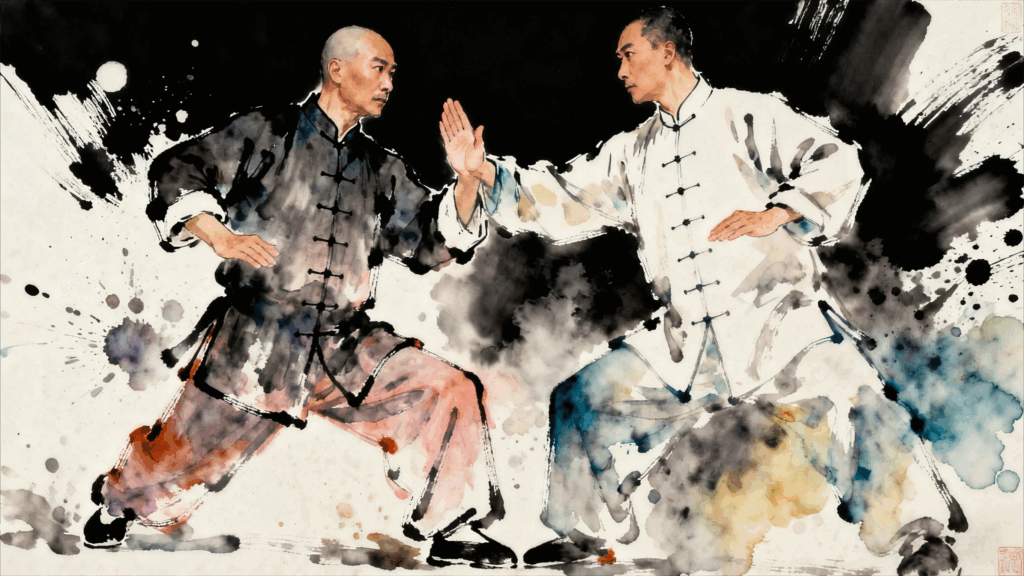
This “softness” has two key features: first, precise control (muscles are not stiff, joints are not stuck, and strength circulates smoothly); second, preparation for exertion (like a slightly pressed spring – it seems relaxed, but can “release force instantly” when needed).
I once met a Tai Chi teacher with ten years of practice. When a young man, unconvinced, pushed his shoulder hard with all his strength (expecting to make him stagger), the teacher only turned his body slightly. The young man’s strength felt like it hit cotton, and he stumbled forward instead. The teacher explained: “I didn’t resist hard. I just ‘guided’ his strength to where I wanted it to go. That’s the role of ‘softness’.”
2. Next, Understand the Principle: The Core of “Overcome Hardness with Softness” Is “Leveraging and Transforming Momentum”
🔍 Key Concept: “Draw In and Empty” (Yin Jin Luo Kong) – “Make Others’ Strength Work for You”
“Draw In and Empty” is the key to “overcome hardness with softness”. Simply put, it means “not opposing the other person’s strength, but ‘borrowing’ their strength and transforming it into your own to push back”.
Take a daily example: holding an umbrella on a rainy day. If a strong wind blows towards you and you resist it by holding the umbrella handle firmly, the umbrella is likely to turn inside out. But if you slightly press the handle in the direction of the wind and adjust the umbrella’s angle along with the wind, the wind will actually help keep the umbrella stable. Tai Chi’s logic of “overcome hardness with softness” is exactly the same as this.
When someone throws a punch (hardness), instead of blocking it directly (resisting), you gently hold their wrist and “guide” it slightly in the direction of their punch (softness) – this is “drawing in”, letting their strength follow your rhythm. At this point, the other person will lean forward due to inertia, losing their center of gravity – this is “emptying”, making their strength lose support. Finally, you use your waist and abdomen to exert force, pushing them slightly in the direction they are leaning – this is “transforming”, using their own strength to make them unbalanced.
Key point: It is not about using “softness” to defeat “hardness”, but using “softness” to make the other person’s “hardness” ineffective, then borrowing their “hardness” to restrain them.
3. Finally, Apply It to Life: How Can Ordinary People Use “Overcome Hardness with Softness”?
💡 Life Application: “Wisdom of Soft Strength” That You Can Understand Without Practicing Push Hands
Some people may say: “I don’t practice Tai Chi push hands, so what’s the use of knowing this?” In fact, the logic of “overcome hardness with softness” can help us avoid many detours in life. Here are two practical scenarios:
Scenario 1: Dealing with “Aggressive Communication” in the Workplace
If you encounter a stubborn colleague who insists on advancing a project according to their plan, arguing with them directly (“Your plan won’t work”) will easily lead to a lose-lose situation.
Instead, use a “soft” approach: first acknowledge their ideas (“This part of your plan is well-thought-out”), then guide them to see the problem (“But wouldn’t adjusting the execution order save more time?”). This not only gives the other person an “out” but also solves the problem more smoothly.
Scenario 2: “Effort-Saving Tip” for Daily Strength Exertion
When lifting heavy objects, many people are used to lifting with their arms, which easily strains the lower back.
Try learning Tai Chi’s “Sink Shoulders and Drop Elbows” (Chen Jian Zhui Zhou): first lower your center of gravity (feet shoulder-width apart, knees slightly bent), let strength flow from your legs to your waist, then use your waist to drive your arms to exert force. This is not only more labor-saving but also reduces the risk of lower back injuries.
Tai Chi’s “overcome hardness with softness” never teaches us to “avoid toughness”, but to “deal with toughness in a smarter way” – just like water, which does not collide with stones but flows around them, yet gradually polishes the stones smooth over time.
This wisdom hidden in “softness” is the true charm of Tai Chi. Next time you see someone practicing Tai Chi, don’t think it’s “slow and weak”. Try to feel the “continuity and momentum storage” in their movements – you may realize that true strength is never about “confronting hardness with hardness”, but about “hiding strength in softness”.